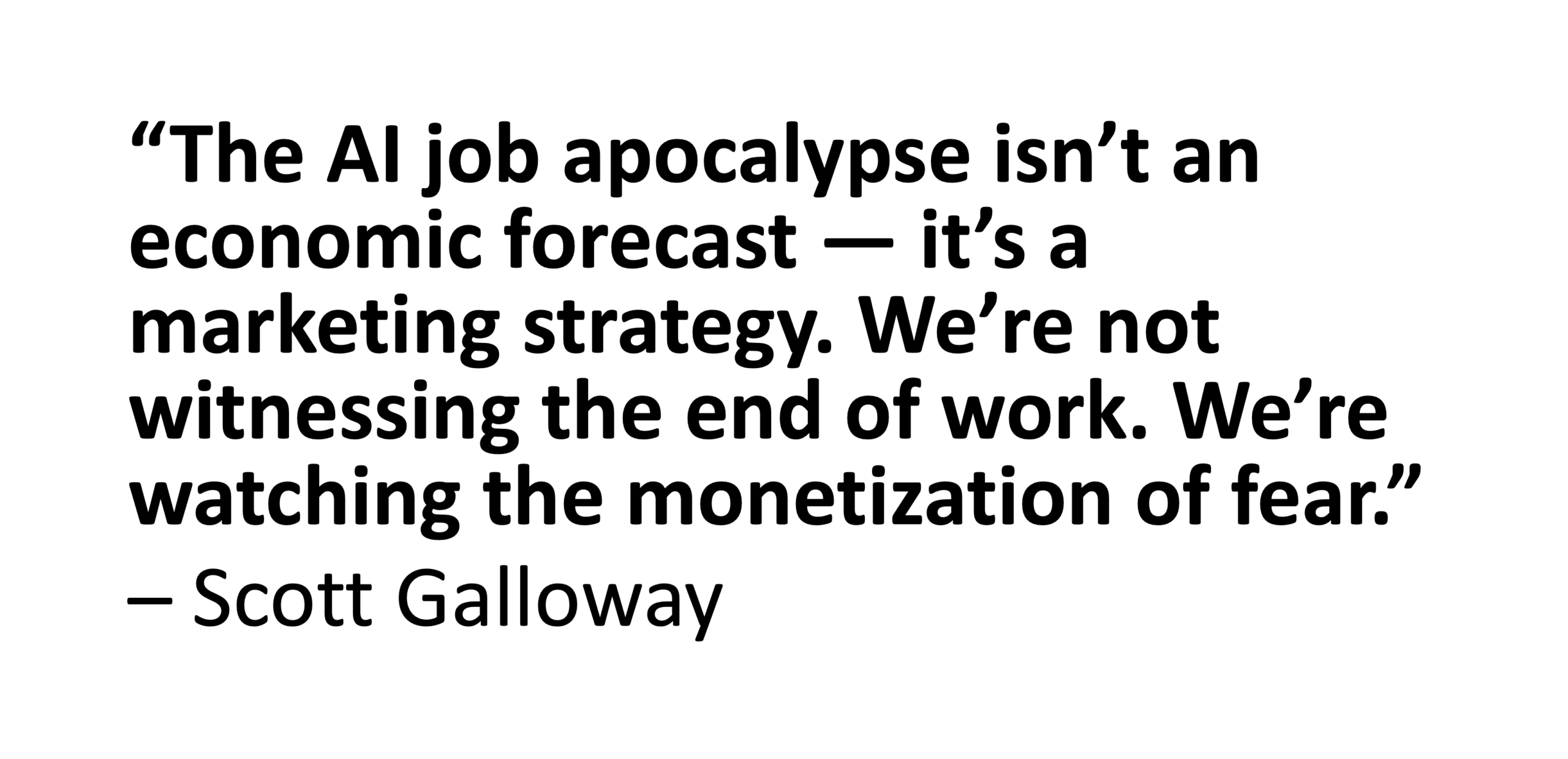
Few brands have fallen further faster in the past 18 months than America and AI. Last week, I wrote about the reckoning I see coming for America. This week, let’s talk about a reckoning I don’t believe will happen: the AI job apocalypse. Every generation gets its “machines will take your job” panic. This one just comes with better PR and a bigger balance sheet. The AI job apocalypse isn’t data-driven — it’s narrative-driven, engineered by people who profit when you’re scared. Fear is the product. Capital is the outcome.
I believe that, similar to every other technological innovation in history, AI will inspire job destruction that will result in an increase in productivity, profits, reinvestment, and (wait for it) jobs. The relevant question isn’t how many jobs we’ll lose / gain, it’s whether the velocity of disruption will overwhelm that period of adaptation and recovery. There are three scenarios: The AI bubble bursts; AI delivers as promised, but on a slower timeline; and AI disruption comes faster than the market can adapt and respond.
Recently, Anthropic CEO Dario Amodei warned that 50% of entry-level tech, legal, consulting, and finance jobs will be completely wiped out within five years. Last year, he told Axios the “white-collar bloodbath” could spike unemployment to 20%. In 2023, when the AI narrative felt more optimistic, Elon Musk said, “There will come a point where no job is needed … AI will be able to do everything.” In 2021, a year before launching ChatGPT, Sam Altman wrote, “The price of many kinds of labor will falltoward zero once sufficiently powerful AI joins the workforce.” Translation: AI is an extinction-level event for workers … according to those who benefit most from AI being an extinction-level event.
Their story is as old as the Industrial Revolution. In Narrative Economics: How Stories Go Viral and Drive Major Economic Events, Nobel Prize-winning economist Robert Shiller argued that fears about machines replacing human labor contributed to 19th century economic downturns. Later, science fiction reinforced the narrative, feeding the incorrect belief that automation caused the Great Depression. Fears about the rise of computers exacerbated the double-dip recession of the early 1980s. The danger, according to Schiller, isn’t labor disruption, but the narrative’s negative feedback loop. “The economic hardships created by a temporary recession or depression are mistaken for the job-destroying effects of the machines, which creates pessimistic economic responses as self-fulfilling prophecies.”
I believe we have the makings for the kind of self-fulfilling prophecy Schiller warned about, as AI-washing masks inflation, tariffs, and over-hiring. Consider tech workers, the supposed canaries in the coal mine. Net technology employment in the U.S. grew from 8.7 million in 2020 to 9.6 million in 2023 and has remained flat since then. Not great, but by no means apocalyptic. Oracle, which laid off 18% of its workforce in March and is projecting negative cash flow until 2030, isn’t capturing AI efficiencies, it’s trading people for chips. Last month’s announcement that Meta would cut 10% of its workforce fed AI anxiety, but in reality Meta is returning to its 2021 headcount. Microsoft’s 7% layoff target would reduce its headcount to 2022 levels, but even after those cuts, Microsoft would still have 47% more workers than it did the year before the pandemic. Since xAI’s 2023 founding, its headcount has grown to an estimated 5,000 people. In March, Musk announced that Tesla would increase headcount, adding, “the output per human at Tesla is going to get nutty high.” The following month, Tesla laid off 10% of its workforce due to poor sales. What we’re seeing isn’t the prelude to a job apocalypse, but a low-hire, low-fire labor market where unemployment rates for tech workers and everyone else are converging around the Fed’s target rate of 4%.
Catastrophizing is a narrative device the hyperscalers deploy to divert capital flows to them and justify their capex. Every new technology in history has gone through a similar arc of creative destruction. I don’t see why AI is any different. As economist Joseph Schumpeter observed in 1942, “economic progress, in a capitalist society, means turmoil.” So far, the turmoil attributed to AI has been more hot air than hard data.
To continue reading this article, click here.