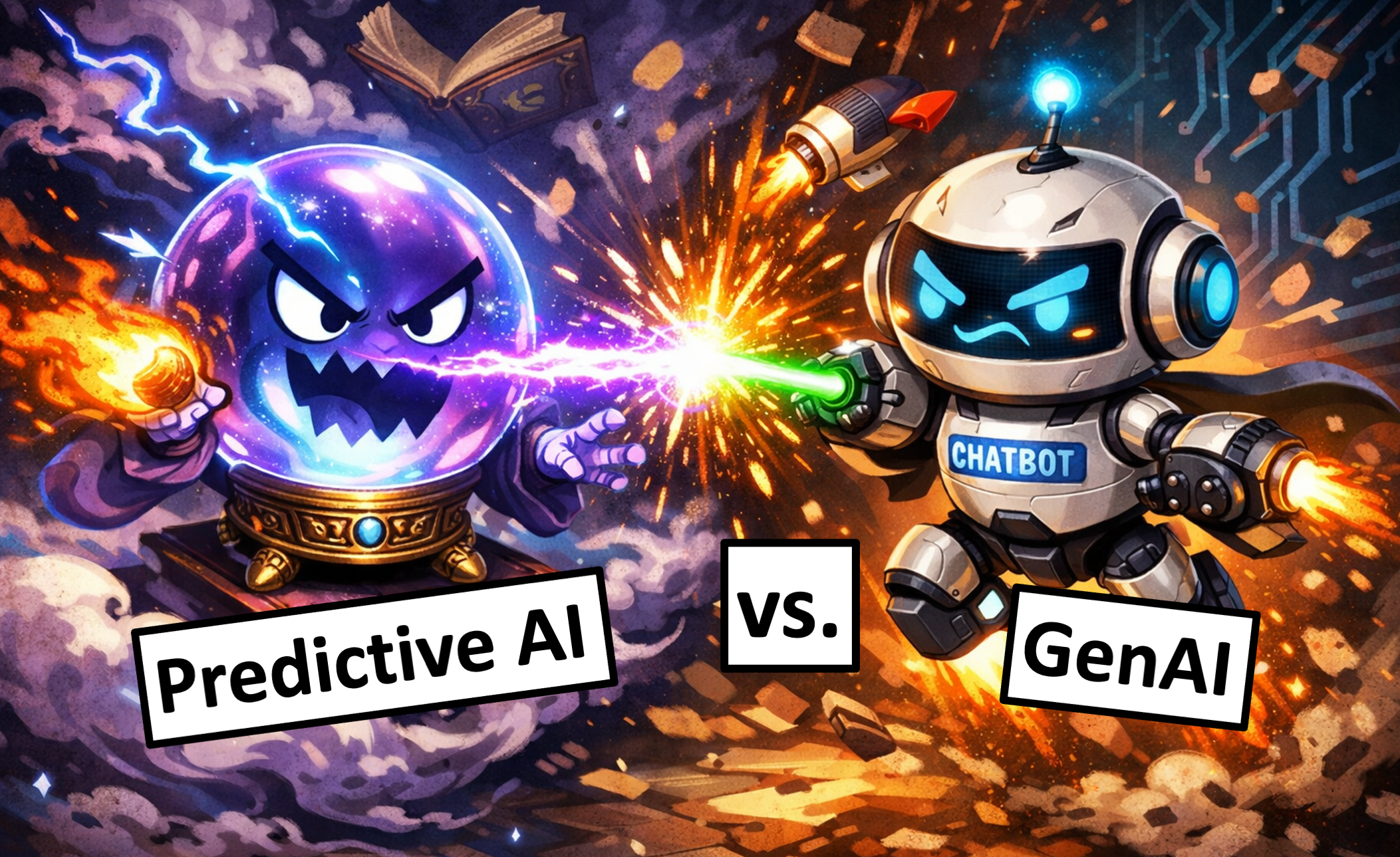
GenAI and predictive AI battle for resources, but even as the overwhelming attention focuses on genAI, enterprises are still adopting predictive AI just as much. ERIC SIEGEL (WITH CHATGPT)
Originally published in Forbes
Generative AI and predictive AI ought to live together in harmony. They solve different problems and present distinct value propositions, so they should compete no more than a water park and a ski resort. In fact, they work best together: Hybridizing the two – using one to help the other – delivers the greatest value for many projects.
But these two flavors of AI compete indeed – for resources, budgets and attention. On that battlefield, genAI appears to be destroying predictive AI. Today’s hype, hoopla and investments seem to take little note of using machine learning to predict, and acting on those predictions to improve operations – i.e., predictive AI. That’s so 2010’s.
But inside the industry, there’s a very different story: When it comes to the sheer number of projects that adopt them, predictive AI is holding its own against genAI. Here’s some evidence, and an understanding as to why the older kind of AI remains relevant.
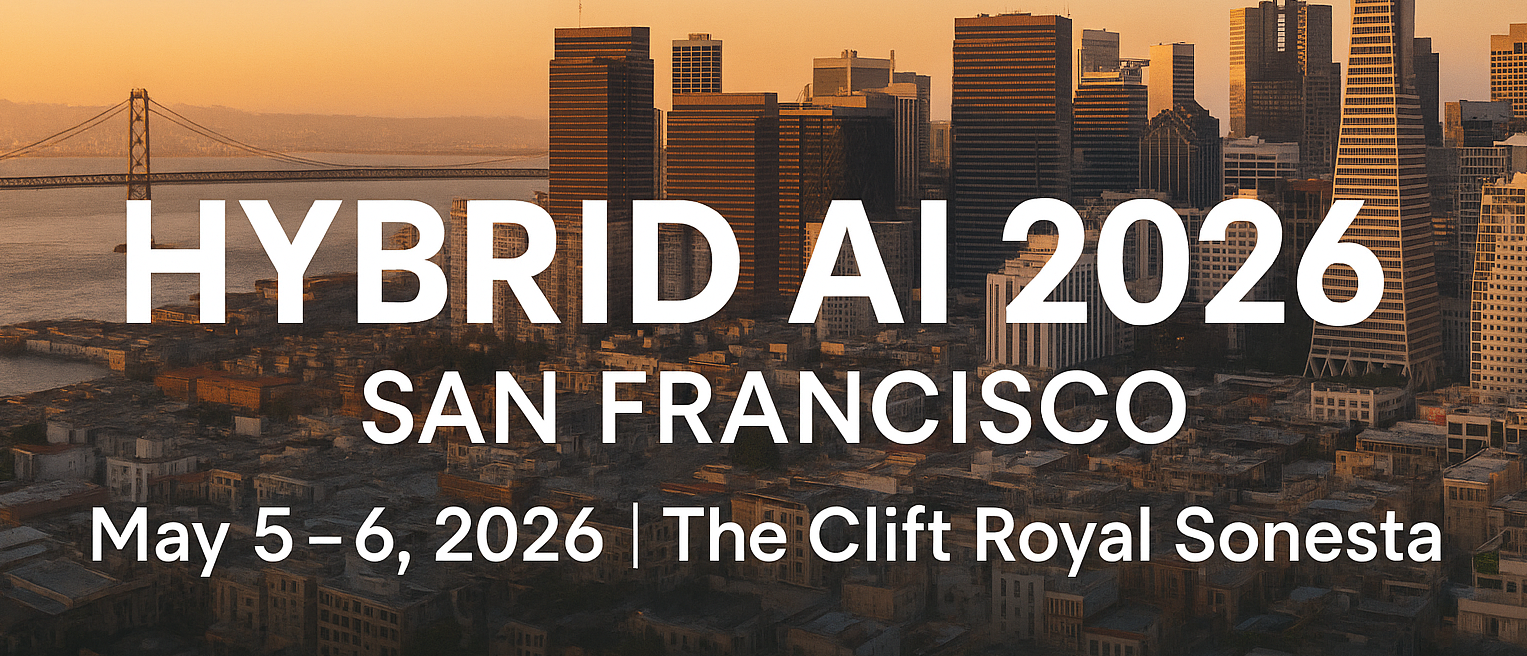
This year’s program at the conference series that I founded in 2009, Machine Learning Week – taking place May 5 – 6, 2026 in San Francisco – shows a roughly equal divide between predictive and generative AI projects.
This balanced spread represents a rough gauge on the industry. Since MLW events are vendor-neutral, their programs have always reflected industrywide trends. Acting myself as the program chair for this year’s edition, I conducted an exhaustive call for speakers that cast a wide net. The submissions accepted into the program reflect the overall distribution of submissions: Predictive AI is thriving alongside its younger sibling, genAI.
The MLW 2026 conference agenda features predictive AI projects such as product recommendations (Spotify), fraud detection (DoorDash), pricing (JP Morgan Chase), predicting insurance claim denials (NextGen Healthcare), medical diagnosis (Axtria), image validation for retailers (Bizom) and anomaly detection for finance.
Balancing this out, the agenda also features cutting-edge use cases of genAI, as presented by the likes of OpenAI, Netflix, Google DeepMind and Amazon. For example, a keynote address from Alphabet X will cover the organization’s moonshot for housing and development, including its “generative architecture” system. This is genAI generating architecture – to scale planning while achieving precision, regulatory compliance and functional performance.
Most projects fall into either the “predictive AI” or “generative AI” category. To be clear, all AI projects are applications of ML – you can think of predictive AI and genAI as two categories of use cases of ML that serve two different purposes. GenAI has the capacity to generate new content items (such as text, graphics or sound), while predictive AI calculates the odds on certain outcomes for individual cases, such as whether each individual will click, buy, lie or die.
Although newer and usually more sophisticated, genAI does not replace predictive AI’s function, it only augments it. Yet many initiatives are designed to equally advance both predictive and generative AI. The MLW 2026 event program includes such presentations covering AI observability (Discover Financial Services and Microsoft), a model validation framework (CSAA Insurance), change-management practices (State Farm) and a data validation framework (Republic Finance).
Why hasn’t the adoption of genAI come to dominate over predictive AI’s? GenAI is more advanced and just plain sexier. LLMs are so good at processing and generating human languages, they seem much more humanlike than computers have ever seemed before, and they even appear to many to be a step toward the “AI” of science fiction. GenAI is so incredibly trendy right now that it attracts much more R&D and startup investment – not to mention headlines. In its general usage, the term “AI” has come to mean genAI in particular, other than in specified contexts.
Here’s why: Predictive AI delivers novel, vital value. It’s older but not “old school.” Most of its potential value is still largely untapped. Predictive AI is the technology you turn to for improving existing large-scale operations, and it often delivers more value than genAI.
The very nature of these two breeds of tech places them on a fairly level playing field. Even if genAI’s underlying tech is more advanced and complex than that of predictive AI, these two forms of numbercrunching offer very different value propositions – the potential value of each depends on exactly what enterprise problem you’re seeking to solve. Moreover, they both struggle to operationalize, for distinct yet parallel reasons: Many genAI pilots are unrealistically ambitious so they don’t achieve the reliability needed to safely deploy; predictive AI projects are complex and hard to sell into the business, so they often fail before deployment as well.
However, a minority of both genAI and predictive projects succeed – and when they do, much value is gained. So we know that there’s potential value; we only need to adjust how the technology is understood, positioned and managed.
Finally, the two are entirely interdependent – they need one another. By combining genAI and predictive AI – using each to address the other’s weaknesses – we stand to multiply the value delivered by technology and core capabilities that already exist today. As a result, genAI’s extreme trendiness implicitly boost’s predictive AI as well. I have argued that securing genAI’s reliability layer represents predictive AI’s new killer app and stands as our last hope before the AI bubble detonates.
Because hybridizing is emerging as a trend, this upcoming MLW event has been dubbed “HYBRID AI 2026,” with the melding of technologies as the main focus and theme. As I covered in a recent article, the event program will feature numerous example enterprises adopting hybrid AI approaches. In fact, most of the predictive AI projects mentioned above incorporate genAI to help.
During keynotes and podcast interviews in recent years, I’ve found myself often saying something that may be innocuous, but that feels subversive in the light of today’s overwhelming focus on genAI: Most organizations should probably invest at least as much into predictive AI projects as genAI projects.
Fortunately, it appears that enterprises have already been prioritizing predictive AI more than I had realized. With genAI’s unprecedented capabilities, it’s amazing how much has changed and yet how much has stayed the same: We can now effortlessly chat with computers, and yet enterprises continue to benefit from predictive AI as well, using it to successfully manage a fundamental, eternal challenge: operational uncertainty.
You can access an overview of HYBRID AI 2026 and a description of each enterprise presentation here (to attend the event on May 5 – 6 in San Francisco, register by March 20 for a price break). Disclosure: As the founding program chair, I am a partial owner of the Machine Learning Week conference series – which includes HYBRID AI 2026 – and I receive an honorarium for chairing.
About the author
Eric Siegel is a leading consultant and former Columbia University professor who helps companies deploy machine learning. He is the founder of the long-running Machine Learning Week conference series, the instructor of the acclaimed online course “Machine Learning Leadership and Practice – End-to-End Mastery,” executive editor of The Machine Learning Times and a frequent keynote speaker. He wrote the bestselling Predictive Analytics: The Power to Predict Who Will Click, Buy, Lie, or Die, which has been used in courses at hundreds of universities, as well as The AI Playbook: Mastering the Rare Art of Machine Learning Deployment. Eric’s interdisciplinary work bridges the stubborn technology/business gap. At Columbia, he won the Distinguished Faculty award when teaching the graduate computer science courses in ML and AI. Later, he served as a business school professor at UVA Darden. Eric also publishes op-eds on analytics and social justice. You can follow him on LinkedIn