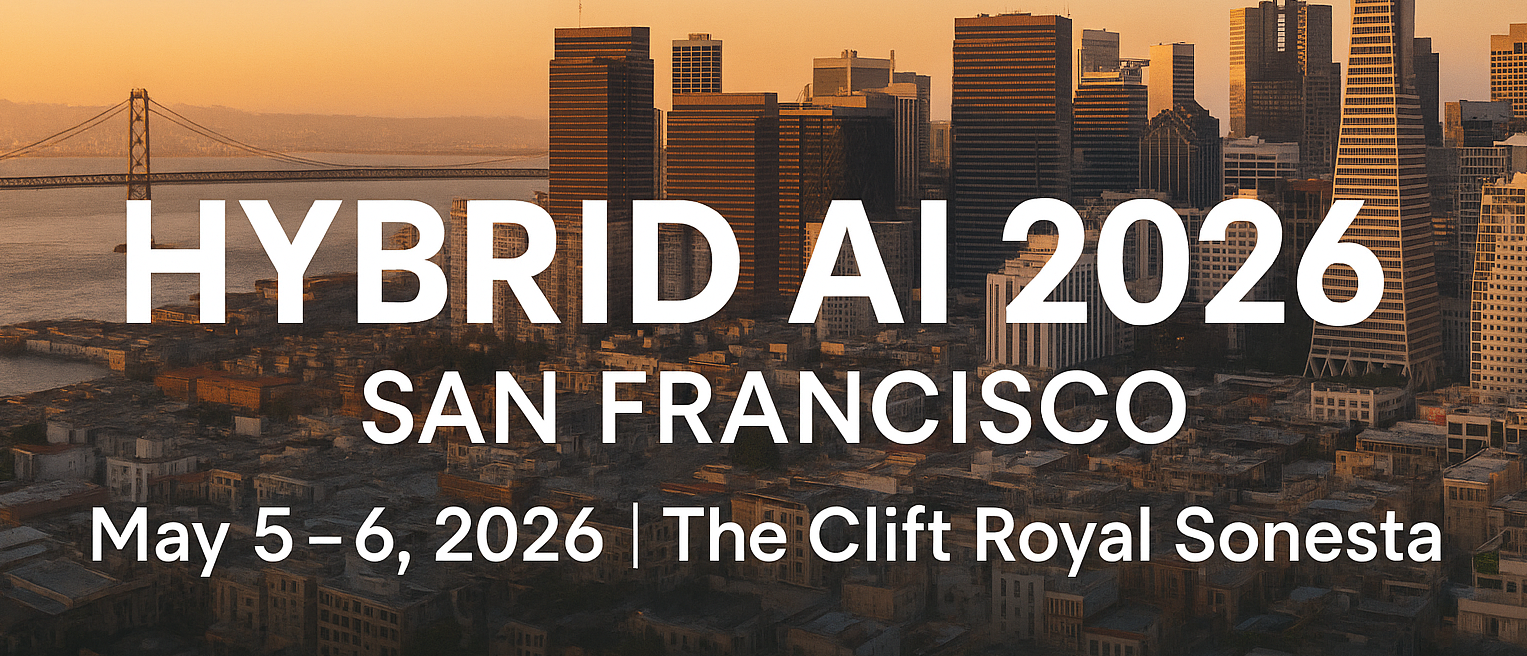
AI is not yet the success that it should be, so two dozen enterprises will disclose their move toward a crucial new paradigm – hybrid AI – at a 2026 conference.
ERIC SIEGEL (WITH CHATGPT)
Originally published in Forbes
After decades chairing and keynoting myriad machine learning conferences, I have witnessed time and again that event programs often signal emerging industry trends. This year, I’m chairing an event where a couple dozen enterprises will disclose their move toward a crucial new paradigm: hybrid AI. Here’s why the AI industry needs to go hybrid and the various ways in which companies are already doing so.
So far, AI is not the success that it should be. As the business world has come to understand, even while many find AI useful, it does not realize anywhere near the mammoth value that’s been promised. Few genAI pilots reach production and few machine learning models deploy.
The hope that we’ll achieve astronomical value endures, but many are betting on an unrealistic story about how we could get there: The core technology will improve, after which sheer machine aptitude will overcome today’s lackluster track record. This has become the common narrative. AI pundits and CEOs routinely declare that, once LLMs get “more intelligent” – or ML models get “more accurate” – the tech will operationalize seamlessly, capturing abundant value for enterprises and their customers.
Not so fast. There’s no miraculous solution on the horizon that’s guaranteed to resolve genAI’s stubborn reliability problem – nor predictive AI’s well-earned reputation for being difficult to use.
Rather than betting on speculative, imagined advancements, I believe that the remedy will come in the form of an innovative paradigm shift: hybrid AI. By combining genAI and predictive AI – using each to address the other’s greatest weakness – we will multiply the value delivered by technology and core capabilities that already exist today.
Predictive AI addresses genAI’s deadly reliability problem. Rather than planning for AI deployments on a hope and a prayer that genAI will become reliable enough to autonomously perform high-level functions, we should recognize that humans will have to remain in the loop. With this in mind, the architecture of an ambitious, genAI-driven system becomes inherently “predictive”: It uses predictive AI to target human intervention, but only for relatively risky situations where human intervention is most likely needed. This way, genAI can still operate autonomously for many cases. This approach will realize a healthy portion of genAI’s often audacious promise of autonomy.
Likewise, genAI addresses predictive AI’s complexity problem. A data scientist can develop a robust model that puts odds on who will click, buy, lie or die – but for model-deployment to get the greenlight, business stakeholders must first delve into a semi-technical understanding of what it means to operationalize such a model, that is, to systematically act on the per-case odds it calculates. LLMs provide the critical spoonful of sugar: A chatbot acts as a friendly expert, increasing understanding and thereby bridging the crippling tech/biz divide that stalemates most predictive AI projects. Moreover, LLMs help make models easier to develop – by way of vibe coding and deriving predictive features from unstructured data – and they provide visibility by describing ML model decisions to laypeople.
Over the last year, I’ve delivered several articles and presentations to pitch these kinds of hybrid AI approaches, including an article on five ways to hybridize predictive and generative AI and another article on two additional ways. I’ve argued that hybrid AI represents our last hope before the AI bubble detonates.
But when I decided to devote the 2026 edition of Machine Learning Week, the conference series I founded in 2009, to hybrid AI, I wasn’t yet sure that the self-evident inevitability of a hybrid approach had yet taken hold in the industry and substantially begun to emerge. Would I be able to fill a two-day conference agenda?
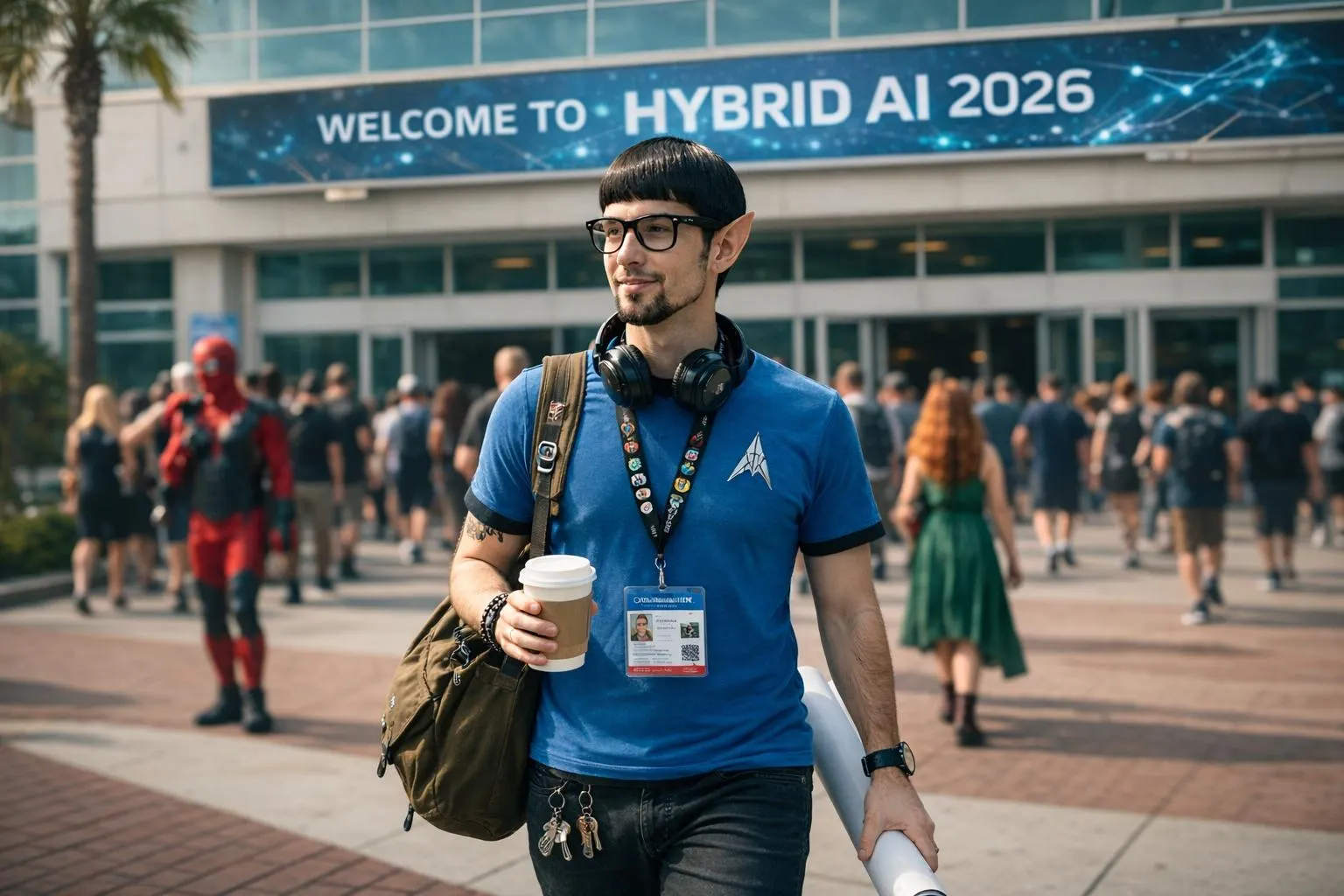
Hybrid is happening. We’re calling this year’s MLW conference HYBRID AI 2026 – taking place May 5 – 6 in San Francisco – and I had no problem filling its program with presentations from numerous companies, including: Alphabet X (Google’s moonshot factory), Amazon, American Express, AWS, Axtria, Capital One, CSAA Insurance (AAA), CVS, Discover Financial Services, DoorDash, Gooder AI, Google DeepMind, HP, IBM, JP Morgan Chase, Microsoft, Netflix, NextGen Healthcare, OpenAI, Republic Finance, Salesforce, Schneider Electric, Spotify, State Farm, Twilio and Wynn Las Vegas.
We’re hearing a clarion call to combine flavors of AI. “Today’s sky-rocketing investment into LLMs is just plain inappropriate,” says IBM Chief Data Scientist Kirk Mettler, who will deliver a keynote address on fusing LLMs with enterprise machine learning. “And yet, not leveraging LLMs to augment predictive AI projects would be just as inappropriate! We hit the sweet spot by blending LLMs with the time-honored tradition of enterprise machine learning.”
He’s not the only one. As detailed in the conference agenda, companies are proving out hybrid AI for an abundance of use cases, including:
Other companies are taking a hybrid approach to secure a much-needed “reliability layer” for genAI across use cases and application areas. As much as the business world would love to see the complete automation of high-level functions – as represented by the ambitious buzzword “agentic AI,” which generally overpromises – many such systems only stand a chance of becoming deployment-ready with predictive guardrails. Salesforce will present on “When AI Agents Go Rogue” and HP on predictively keeping humans in the loop. And I’ll open the event with a keynote on how securing genAI’s reliability layer represents predictive AI’s new killer app.
Beyond the core conference agenda, it turns out that educational programs about hybrid AI are also in demand. This hybrid AI event will hold pre- and post-conference training workshops run by industry leaders James Taylor and Dean Abbott.
It’s high time that enterprises begin to achieve the AI value everyone talks about but few realize. The world needs it to be so – not only to improve AI so that it gets closer to realizing the promises on which so many have placed tremendous bets, but also because value is the whole point… efficiency improves the world’s prosperity. This is the very purpose of tech.
I’m excited to see this crucial industry direction come to fruition. Not only was there an overwhelming, competitive response to our initial speaker call on the topic of hybrid AI to build the event agenda, we still continue to receive a steady stream of speaker submissions despite the stated deadline of three months ago atop the submission form. Moreover, event interest and feedback from tenured professionals has consistently reaffirmed that, in the AI industry, the argument for hybrid AI is resounding.
The world can’t afford to wait for speculative and potentially infeasible advances that would achieve an unprecedented degree of technological “smartness” and human-level capability. Instead, blending the two main flavors of AI – predictive and generative – directly addresses their respective limitations and empowers companies to realize value today.
You can access an overview of HYBRID AI 2026 and a description of each enterprise presentation here (to attend the event on May 5 – 6 in San Francisco, register by March 20 for a price break). Disclosure: As the founding program chair, I am a partial owner of the Machine Learning Week conference series – which includes HYBRID AI 2026 – and I receive an honorarium for chairing.
About the author
Eric Siegel is a leading consultant and former Columbia University professor who helps companies deploy machine learning. He is the founder of the long-running Machine Learning Week conference series, the instructor of the acclaimed online course “Machine Learning Leadership and Practice – End-to-End Mastery,” executive editor of The Machine Learning Times and a frequent keynote speaker. He wrote the bestselling Predictive Analytics: The Power to Predict Who Will Click, Buy, Lie, or Die, which has been used in courses at hundreds of universities, as well as The AI Playbook: Mastering the Rare Art of Machine Learning Deployment. Eric’s interdisciplinary work bridges the stubborn technology/business gap. At Columbia, he won the Distinguished Faculty award when teaching the graduate computer science courses in ML and AI. Later, he served as a business school professor at UVA Darden. Eric also publishes op-eds on analytics and social justice. You can follow him on LinkedIn